Advanced Techniques For Blues Guitar Players
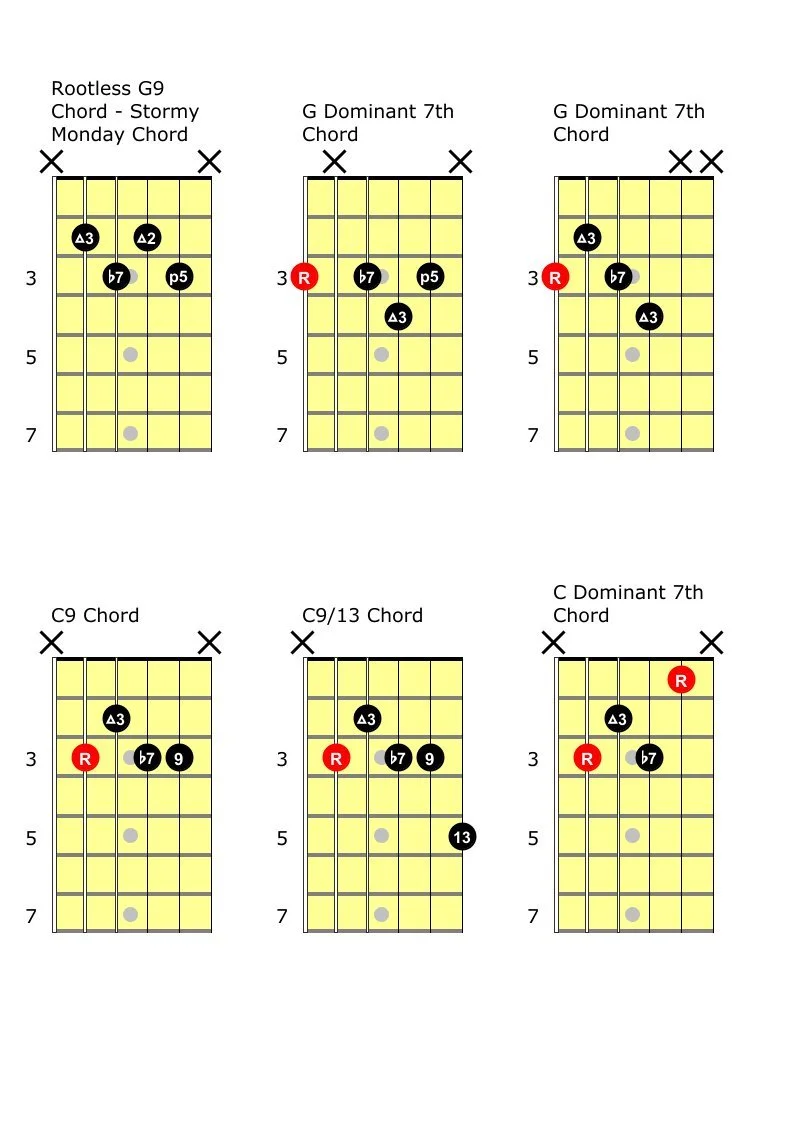
These Dominant chord voicings will give you more options when playing rhythm guitar and help take your playing up a notch.
Understanding different chord voicings is essential for playing blues guitar because blues is not just about scales and solos — it’s about rhythm, feel, harmony, and expression. The way you voice a chord can completely change the groove, mood, and energy of a blues progression.
Here’s why chord voicings matter so much in blues:
1. Adds Depth and Color to the 12-Bar Blues
The standard 12-bar blues uses dominant 7th chords (I7, IV7, V7). If you only play one basic shape (like open-position E7, A7, B7), your playing can sound repetitive.
By learning different voicings — such as:
Rootless dominant 7ths
9th chords (e.g., E9, A9)
13th chords
Partial triads on the top strings
—you create richer harmonic textures and a more professional blues sound.
For example:
A plain E7 sounds solid.
An E9 instantly gives you that Chicago or Texas blues flavor.
A tight 3-note voicing higher up the neck sounds more modern and funky.
2. Improves Voice Leading and Smooth Transitions
Good blues rhythm playing isn’t about jumping around the neck — it’s about smooth movement between chords.
Different voicings allow you to:
Stay in one area of the neck.
Move individual notes by half-steps.
Create subtle melodic movement inside chord changes.
This technique (called voice leading) makes your rhythm playing sound sophisticated and connected instead of clunky.
3. Makes You a Stronger Rhythm Guitarist
In blues, rhythm guitar is just as important as lead guitar. Professional Blues guitar players all use varied chord voicings to add punch and dynamics to their rhythm playing.
Different voicings help you:
Accentuate the groove
Control dynamics
Support the singer or soloist
Avoid clashing frequencies in a band setting
4. Helps You Play in Any Key Anywhere on the Neck
Blues musicians often change keys depending on the singer or band. If you only know open chords, you’ll struggle outside a few keys.
Learning movable voicings (based on E-shape and A-shape barre chords, triads, and shell voicings) allows you to:
Play blues in any key
Jam confidently
Adapt quickly in live situations
5. Opens Up Turnarounds and Fills
Many blues turnarounds use partial chord voicings on the top three strings. When you understand chord construction, you can:
Add melodic fills between chord hits
Create walking chord lines
Blend rhythm and lead seamlessly
This is what makes a guitarist sound authentic rather than mechanical.